ここから本文です
TWO:

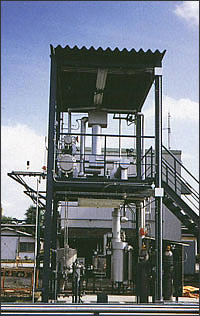
Membrane separation type solvent dehydration system

Great attention is recently being paid to global environmental issues, and it is now conceivable that companies will need to treat used solvents themselves. In consideration of this kind of social issue, we have developed a “membrane separation type solvent dehydration system,” which uses a polyimide membrane with superior dehydration properties developed by Ube Industries, Ltd. in combination with our own distillation and concentration technology that has resulted in solvents being more easily recovered.

THREE:The End
  • 1Under the distillation system, even in case of azeotropic solvent compositions, this system which remove water vapor by the polyimide membrane will easily dehydrate.
  • 2In comparison with the distillation system, it significantly saves on use of steam.
  • 3Dehydration can be performed through merely supplying evaporated vapor to the membrane module and maintaining the differential pressure between the permeable side and the impermeable side.
  • 4Solvent purity of 99.9% or more can be achieved by carrying out dehydration with a polyimide membrane only.
  • 5The polyimide membrane has superior heat and solvent resistance. Therefore, the vapor permeation system reduces contamination of the membrane and thus extends its life.
THREE:[See larger version]

The aromatic polyimide membrane is highly permeable to water vapor but less permeable to vapors of organic compounds such as alcohol etc.

THREE:At the period at which we have now arrived France was in a state of the wildest and most awful convulsion. A revolution had broken out, more terrible and furious than had ever yet appeared in the history of nations. The French people, so long trodden down by their princes, their aristocracy, and their clergy, and reduced to a condition of wretchedness and of ignorant brutality, almost unparalleled, seizing the opportunity of the distresses of the impoverished Government, and encouraged by a new race of philosophers who preached up the equality of the human race, had broken through their ancient subserviency, and were pulling down all the old constituted powers, ranks, and distinctions, with a rapidity which electrified the whole world.
  • 1 Recovery of the detergent solvent Recovery of the cleaning solvent such as electronic parts industry, precision instrument industry.
  • 2Solvent recovery and the refinement Solvent recovery and the refinement such as chemical industry, an industry of medical supplies, food industry, the fermentation industry.
THREE:Lower Canada was inhabited chiefly by French Canadians, speaking the French language, retaining their ancient laws, manners, and religion, wedded to old customs in agriculture, and stationary in their habits. Of its population, amounting to 890,000 in 1852, nearly three-fourths were of French origin, the remainder being composed of emigrants from Great Britain and Ireland and other countries, while in Upper Canada the number of French was under 27,000. Lower Canada, however, might have been expected to make much more rapid progress from its natural advantages in being much nearer to the seaboard of the Gulf of St. Lawrence, and being enabled to monopolise much of the ocean navigation, which terminated at Montreal. Thus, the cities of Quebec and Montreal rose quickly into importance when the Upper Province began to be settled. In 1827 the cities had each a population of above 27,000; but by the census of 1852 it was found that Quebec had a population of 42,000, and Montreal 57,000. The growth of the towns of Upper Canada was still more rapid. In 1817 Toronto, then called Little York, had only 1,200 inhabitants; in 1826 it had scarcely 1,700; but in 1836 it had risen to 10,000. Among the other principal towns of Upper Canada were Hamilton, Kingston, London, and Bytown (now called Ottawa), which grew rapidly. Situated so near Europe, and offering inexhaustible supplies of fertile and cheap land, with light taxes and a liberal government, it was natural to expect in Upper Canada a mixed population, and an analysis of the census of 1852 showed that its inhabitants were composed of people from most of the countries of Europe. The largest single element was composed of Canadians, not of French origin, upwards of half a million; the next of Irish, 176,267; then English, 82,699; Scottish, 75,811; from the United States, 43,732; Germany and Holland, 10,000. Many of those settlers emigrated from the old countries to avoid the pressure of distress. They consisted, to a large extent, of the worst paid classes of workmen, such as hand-loom weavers, that had lost employment by the introduction of machinery. Those persons were now found to be in the enjoyment of independence, as the proprietors of well-cleared and well-cultivated farms, having all the necessaries of life in abundance.

Acetone, ethanol, methyl ethyl ketone, butanol, isopropyl alcohol, ethyl acetate, methyl isobutyl ketone, others (including hexane and toluene).